
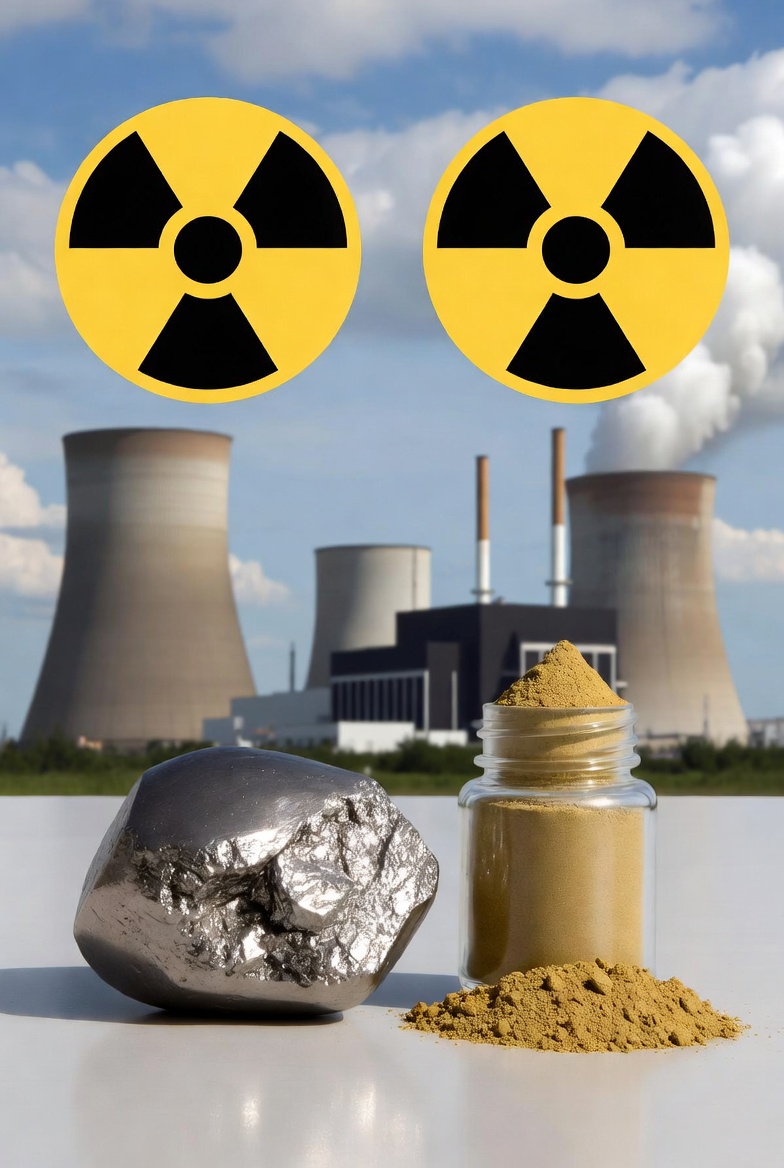
What is Uranium?
Uranium (chemical symbol: U) is a dense, silvery-white metallic element important for its use as fuel in nuclear reactors. With an atomic number of 92, it is the heaviest naturally occurring element and a key commodity in the burgeoning energy sector, especially for nuclear energy production. Since mined uranium is radioactive from its decay products, especially radon-222 gas, it must be handled carefully with radiation monitoring, personal protection from dust and gas control, and careful handling of its tailings and waste products.
How and Where is Uranium Mined?
Uranium mining primarily occurs through two methods: conventional mining and in-situ recovery (ISR).
- Conventional Mining: This method involves extracting uranium ore from the earth through open-pit or underground mining operations.
- In-Situ Recovery (ISR): A more environmentally friendly approach, ISR involves pumping a solution into the ground to dissolve the ore, which is then brought back to the surface for processing.
Top 3 Uranium Producers
- Kazakhstan: The world leader in uranium production, Kazakhstan utilizes ISR for approximately 57% of its output, providing a significant portion of global demand.
- Canada: Renowned for high-grade uranium deposits, Canada’s conventional mines, such as the Cigar Lake and McArthur River mines, contribute substantially to the market.
- Australia: With notable mines like Olympic Dam and Ranger, Australia is a key player in uranium production.
How is Uranium Refined?
Once extracted, uranium ore undergoes a refining process that includes:
- Crushing and Grinding: The ore is crushed and ground into a fine powder.
- Leaching: The powdered ore is treated with acid or alkaline solutions to dissolve the uranium content, producing a yellowcake (U3O8).
- Conversion: The yellowcake is converted into uranium hexafluoride (UF6) gas for enrichment.
- Enrichment: This process increases the proportion of uranium-235, which is essential for nuclear reactions.
Current Supply/Demand Balance in 2026 and Next 10 Years
The outlook for uranium is characterized by growing demand due to the nuclear power sector's expansion. By 2026, it is projected that the annual demand will reach about 150,000 tonnes, nearly doubling from previous estimates, driven by a resurgence in nuclear energy fortifying the grid.
- Supply Constraints: Many high-grade mines remain dormant or underutilized, affecting supply. Additionally, geopolitical tensions, particularly concerning Russian imports, amplify concerns over availability.
- Future Projections: Looking ahead to 2040, the cumulative uranium supply gap could reach 680,000 metric tonnes, substantiating the necessity for new mining projects and innovations in extraction.
Primary Uses for Uranium
Uranium's most significant application lies in nuclear power generation. Examples include:
- Power Generation: Uranium fuels nuclear reactors, providing a stable, dense energy source that has a low carbon footprint compared to fossil fuels.
- Defense Applications: Uranium is also critical for military purposes, including naval propulsion systems and nuclear weapons.
Why is Uranium Considered a Strategic Metal?
Uranium is deemed a strategic metal due to its essential role in achieving energy independence and sustaining large-scale energy needs. As reliance on clean energy grows, uranium becomes vital for:
- Energy Security: Countries can reduce dependence on transient fossil fuels by investing in nuclear power.
- Economic Stability: With the global push for low-emission alternatives, uranium mining and processing provide economic opportunities and job creation.
Uranium-Powered Nuclear Plants: Optimal for AI Data Centers
The rise of artificial intelligence necessitates a reliable and substantial energy supply, making uranium-powered nuclear plants attractive for powering data centers. Here’s why:
- High Energy Output: Nuclear plants produce vast amounts of energy continuously, unlike solar or wind, which are intermittent.
- Low Operational Costs: Once constructed, nuclear plants have low operational costs, providing a steady and predictable energy source.
In conclusion, as we forge ahead into an era reliant on advanced technology and AI, uranium stands as a pivotal component of our energy strategy. Its potency as a strategic metal will guide us toward a more sustainable future, illuminating the pathways to innovation.
Remember, if it can't be grown then it has to be mined.