Embracing the Hybrid
Sometimes I stand at the edge of a forest in twilight or beside a silent canal and I already feel it happening: the moment when the boundary between what I see and what I capture begins to dissolve. My camera does not merely record light and form, it also catches something that reaches further: a mood, a vibration, a whisper from nature that I cannot fully name. These images, often born from intentional movement, long exposures, or extreme reduction, already feel half like paintings even before I edit them.
A Dance of Inspiration
Take, for example, the bare tree branches I recently photographed: a tangle of dark lines against a soft, almost monochromatic background. In black-and-white they become a graphic network, an organic script that could easily inspire a painter to enlarge such branch structures with palette knife and thick paint.
Or the winter mist over a polder, where a flock of geese glides through the frame as a dark V-shape: the mist softens everything into a dreamy gray field, the birds become a rhythmic line, a gesture that could almost be set down with a single brushstroke.
Translating Visions
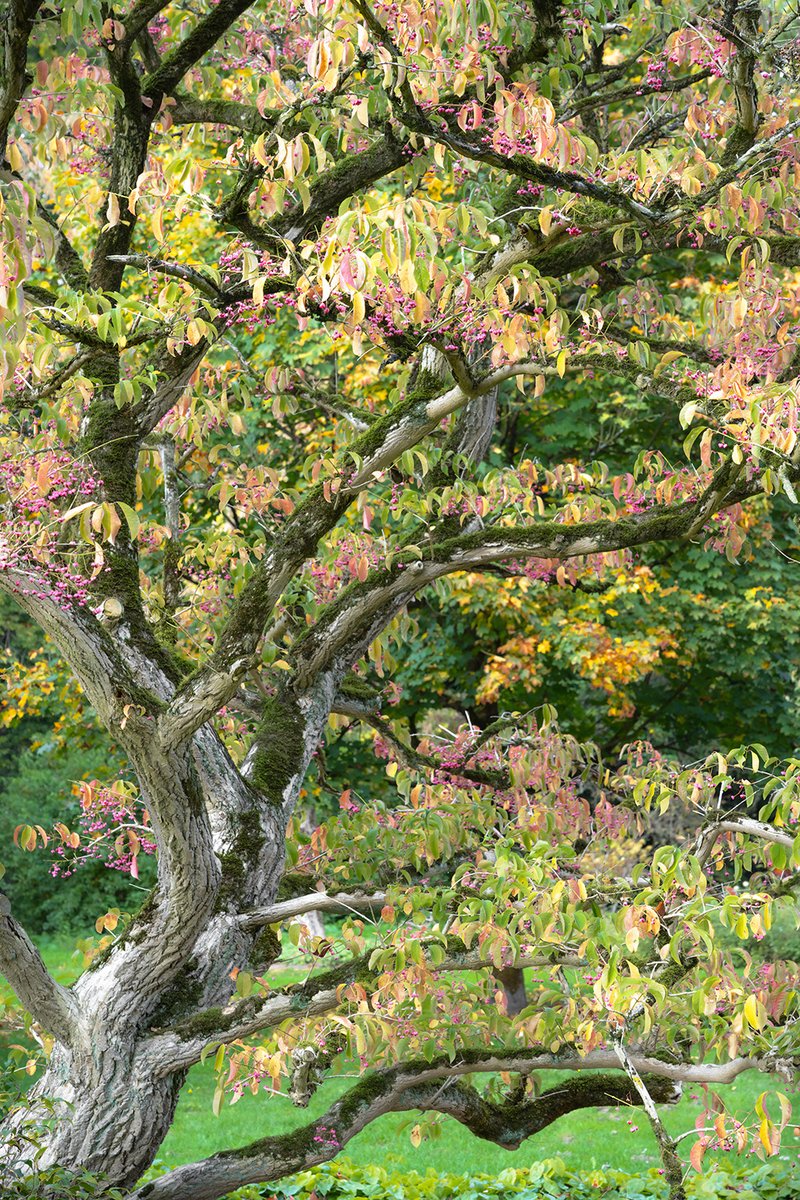
And then the last leaves still clinging to a branch, vivid pink berries against autumn yellow foliage and moss-green bark: that image practically begs for oil paint. The texture of moss, the gloss of the berries, the translucent leaves in backlighting. They are no longer documents; they are already studies in form, color, and emotion. I imagine what it would be like if a painter took these photographs as a starting point. Not to copy them literally, but to translate them.
Creating New Dialogues
The photographic blur of an ICM forest becomes a series of loose, rapid brushstrokes à la Van Gogh, but then in the soft, almost monochrome gray tones that my Dutch mornings so often carry. The long exposure of a misty goose flock becomes a swirling mass of dark lines over a diffused field, not as explosive as Van Gogh’s starry skies, but with the same inner movement, the same emotional charge.
The berry bush with its pink accents against yellow and green could become a study in contrast and texture, where the moss is built up with palette knife until it feels almost touchable, just as the bark and leaves feel in reality.
Conversely, I just as eagerly imagine the other direction. Imagine an abstract painting, say a work with heavy, cracked layers and intense color fields, being photographed by me under the Dutch light I know so well: diffused, cool, sometimes almost hesitant.
Bridging Two Worlds
That photograph, now itself a new object, enters the digital darkroom. I apply motion blur to make the brushstrokes wave, split toning for a melancholic glow, Orton effect for dreamlike softness, and extreme clarity boosts on the texture to give the surface even more relief. What emerges is no longer a reproduction but a new hybrid being: a digital abstract work born from a physical painting, yet now breathing with the breath of photography.
An Invitation to Collaboration
This is what I call transmedial art, or perhaps better: hybrid art. It is not a hierarchy between old and new, between paint and pixel, between painter and photographer. It is a conversation across media; an exchange of energy. A painter can be inspired by the way a long shutter speed turns movement into fields of tone, or by the way mist reduces an entire scene to a soft gradation of gray. A photographer can learn from the physical courage required to cut and build with knife and brush, from the texture that only arises through repeated layers and touch.
I believe there are painters who could be inspired by images like these. Not to imitate them but to distill something new from them. The gentle fading of mist in an ICM forest, the graphic repetition of reflection lines in a polder ditch, the almost tactile grain of sand under diffused light, the last leaves and pink berries still clinging to a branch; these are all qualities that lend themselves to canvas, brush, and palette knife.
A New Artistic Language
Conversely, I invite painters: let me photograph your work. Under the light I know, the Dutch light, diffused, cool, sometimes almost hesitant, and then let me play with those images. Not to improve or “digitize” them, but to give them a new life in a different language. Perhaps something will emerge that is neither pure painting nor pure photograph, but a third thing: a hybrid object that carries both worlds within it.
I can already see it: an exhibition where physical paintings hang beside their digital offspring, where the viewer walks back and forth between canvas and screen, between touch and light. Where one person feels the texture of paint and another experiences the infinite subtlety of a pixel grid. Where the work does not end at the edge of the canvas or the shutter, but continues in the gaze and imagination of those who look.
Reflecting on the Future
This is not a plea for technological progress or nostalgia for craftsmanship. This is an invitation to exchange. To conversation. To new forms of making and seeing.
I am curious who will take the first step. How does this inspire you?
Light and shadow, always,
Lumière Novan (Luno)
Luminos Magazine - Eternal Gardens 🌿📸